


aegean
-
Posts
335 -
Joined
-
Last visited
Never
Content Type
Profiles
Forums
Gallery
Events
Articles
Media Demo
S30z Register
Store
Everything posted by aegean
-
Neat trick !
-
I can't tell you the production date, but the compliance date is 7/74 and the chassis number is GRS30 000692. I have the steel spare wheel, but the car is in storage at the moment, so I can't get to it to check the date on the wheel.
-
Let me know when you get some mags. I am not in a hurry and also don't need the tyres.
-
Why would they want to ?
-
Actually, I don't disagree with you, but I want to make it as stock as possible. If it was a high mileage, modified car, I wouldn't bother, but since it has yet to break 100,000 km, I just thought it would be a nice touch. I will keep the mags and have them refurbished. The spare incidentially is a steel wheel, so I presume they only fitted the mags to the 4 road wheels.
-
This might answer that

-
I am only going on original (Australian) brochures, which shows them with steel wheels. I am happy to be corrected.
-
I'm assuming this is what it is called. Anyone know if you can still get the rubber for it ? Mine is cracked/split - I guess they probaby all are by now, or missing altogether. Haven't looked at it closely, but I would guess they were a rubber tube that was put on over the metal tubing before one end was welded up with the hinge, so I guess installation would be the reverse,
-
I have decided to take the car back to standard 14" steel wheels with hub caps, so if anyone has up to 4 steel wheels they don't need/want, please let me know. Would prefer them to be in Melbourne, and I am in no hurry. I don't know if it'r relevant, but they are for a '74 2 + 2.
-
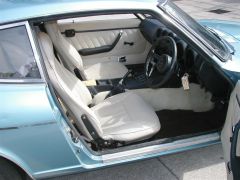
Front and rear seats I had made up in the US from original vinyl (and seems to be correct, but I haven't put them side by side against the ones in the car) to compare the grain. They were supplied with the correct vent holes etc. Cost was US$300 including shipping. The tunnel vinyl is available from the US, and is made by Distinctive Industries. They make it for all of the companies that make up the kits. However, I first contacted them in November last year, and received a reply in July ! They said that it was 18" wide by 60" long, and US$75 a sheet. When I sent them photos of the two types - 240 and 260, that was the last I heard. I have sent them reminders, but based on their initial time to make contact, I am not expecting a reply any time soon.
-
Not in this case ! This one is only a 2lt 4 cylinder boxer engine. My Tatra 603 is a V8 though. Here is a photo of the 600 engine
-
This is a photo of a Tatra 600 (Tatraplan) that I am planning to restore sometime in the future. This is not my car - mine needs a little more work than this one ! Even though this is a 1950 model, it's design came from the previous models of the '30's, such as the T77, T87 and T97.
-
Lawrence Livermore Laboratories has discovered the heaviest element yet known to science. The new element, Governmentium (Gv), has one neutron, 25 assistant neutrons, 88 deputy neutrons, and 198 assistant deputy neutrons, giving it an atomic mass of 312. These 312 particles are held together by forces called morons, which are surrounded by vast quantities of lepton-like particles called peeons. Since Governmentium has no electrons, it is inert; however, it can be detected, because it impedes every reaction with which it comes into contact. A tiny amount of Governmentium can cause a reaction, that would normally take less than a second, to take from four days to four years to complete. Governmentium has a normal half-life of 2- 6 years; It does not decay, but instead undergoes a reorganization in which a portion of the assistant neutrons and deputy neutrons exchange places. In fact, Governmentium's mass will actually increase over time, since each reorganization will cause more morons to become neutrons, forming isodopes. This characteristic of moron promotion leads some scientists to believe that Governmentium is formed whenever morons reach a critical concentration This hypothetical quantity is referred to as critical morass. When catalyzed with money, Governmentium becomes Administratium, a related element that radiates just as much energy as Governmentium, but has half as many peeons and twice as many morons. There are strong indications of the existence of local variants of Governmentium. Strangely, these variants do have electrons, but they appear to be entirely negatively charged and therefore highly unstable. These variants are known informally as local Governmentium, and appear subject to regular chaotic events, also related to catalytic reactions with money, which result in them being converted to Administratium. On gravity maps they appear as localised black holes, leading to speculation that they are actually composed of anti-matter particles.
-
Sounds like the old head has been shaved and may be under tolerance.
-
The next thing I would be doing is a leak down test. This will explain how if you are now familiar with how to do this. http://autos.yahoo.com/maintain/repairqa/engine/ques057_1.html
-
ATF won't hurt your carbies - or anything else, but it will clean the varnish out, so that's why I said to have filters on hand. Vacuum advance only affects the idle speed and at low revs so that isn't going to change too much, but still better to replace it. Look for vacuum leaks at the same time. All will effect the timing and tuning.
-
-
-

From the album: New album
-
From the album: New album
-

From the album: New album
-
They come up reasonably often on eBay US. I presume there wasn't a book unique to Australia. There was one for sale last week with a Buy it Now for US$49 - it sold.
-
This has been something used for many years by Mercedes owners with high compression/output engines - such as the 6.3, 6.9, etc. I have a few of them, and believe me, it works. You also don't need to use new oil - any old ATF that has been filtered is fine. It is especially good in fuel injected engines as it cleans the injectors as it goes. Also good for cars that don't get a lot of use as it cleans out the varnish that forms on the fuel lines - and that is why I said you need to have new filters on hand.
-
Sounds more a case of pre-ignition, caused by excessive carbon on the heads. Might be time for a de-coke. You could try running some ATF (auto transmission fluid) through the fuel for a few weeks - about 1lt per tank full, and that may clear it after a few weeks. You will need to have some new fuel filters on hand though as it will clean out the entire fuel system. Another option is to pout water SLOWLY down the carbie while it is running abd try and burn it off.
-
Flicking through my owners handbook, I noticed that the paint code is lited as 305H. While I know that 305 is Light Blue Metallic, does the "H" stand for Dr Herbert - a paint manufacturer that it no longer in existance ? I couldn't find any reference to the H on this, or any other Z site.
-
What the real reason was is anyone's guess. The rest of the engine bay wiring (and the rest of the car for that matter) is completely original as far as I can tell, or at least, what you would expect for a 96,000 km car.


